The inauguration

January 24th, 2009 § Leave a Comment

I should have posted about Barack Obama’s inauguration days ago, when all of this was more relevant. But I didn’t have much to say that was insightful or eloquent. Of course the event was thrilling, and inspiring. It’s great to have a new president, and, as I’ve said before, what a president he is. The simplest, best element of this new reality is that this Washington Post headline could be written: “Obama Starts Reversing Bush Policies.”

One TPM reader less than a year older than me perfectly summarized my feelings about the day and the new era beginning:

From TPM Reader AH …

George Bush was sworn in just before my 13th birthday, and i really the only president I’ve ever known (aside from my passing awareness of Lewinsky-era Clinton). I’ve never known a world in which government could be trusted, or where I really thought the president’s administration had noble aims. I think the Bush administration has bred a deep cynicism in people my age who’ve never known better. Now, a few weeks before my 21st birthday, Obama’s inauguration means that, for the first time in my life, I’ll be able to believe in government, and feel like it’s actually my government. For the first time I can remember, government can be, as it should be, a force for good and decency.

My appreciation for the event of the inauguration, however, was tempered by my unfair disdain for all the people I know skipping school to head to Washington. I have ideas about good and bad reasons to miss out on obligations, and symbolic ceremonies don’t count as a good reason by my prejudiced logic. Plus the inauguration fell almost six years to the day (six years and two days) after I felt moved to head to Washington. That day I was with only about a hundred thousand other people, not one-and-a-half million, and we were trying to stop a war, not welcome a new president. It would have been nice if as many people as wanted to see Barack Obama inaugurated had decided to come to Washington on January 18, 2003. Maybe it (I should should own up to my agency and say “we”) would have made a difference. But by now, in part because of that experience, I don’t believe strongly in protests. So I don’t know. This is about as deep as my acknowledged hypocrisy and bias goes. Anyway, I’m glad Obama’s in office.

Here‘s the YDN editorial I wrote after Obama’s address yesterday.

And here’s the most visually beautiful thing to come out of the event (even though I don’t understand how or why inaugural balls still exist):

P.S. On another subject, here‘s another editorial I penned last week, commending Yale for rejecting the SAT’s new Score Choice option.

My favorite story of 2008; my story in 2009?

January 6th, 2009 § Leave a Comment

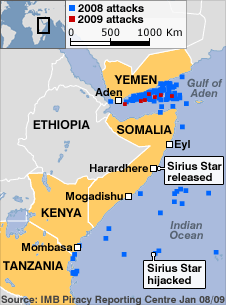
Since September, when Somali pirates hijacked a massive Ukrainian cargo ship, Western media sources have told the greatest tales a kid could hear. Played out in newsprint the old-fashioned way, with updates released slowly, over days and weeks, the stories have brought us pirates in skiffs and trawlers taking on grand tankers, cargo ships, and even passenger cruisers, events impossible to imagine from thousands of miles away and in life on land. No good guys and bad guys in these, for how could you root against the dozen rag-clad rebels who took down the giant in their waters? Forget that they’re criminals; they’ve got everything heroes have. And if you believe them, they’re fighting for justice. In a New York Times article from September 30, 2008, Jeffrey Gettleman wrote about the pirates who had seized the Ukrainian ship, and shared what they want. Check out, too, how this one was reported:

“We just saw a big ship,” the pirates’ spokesman, Sugule Ali, said in a telephone interview. “So we stopped it.”

The pirates quickly learned, though, that their booty was an estimated $30 million worth of heavy weaponry, heading for Kenya or Sudan, depending on whom you ask.

In a 45-minute interview, Mr. Sugule spoke on everything from what the pirates wanted (“just money”) to why they were doing this (“to stop illegal fishing and dumping in our waters”) to what they had to eat on board (rice, meat, bread, spaghetti, “you know, normal human-being food”).

He said that so far, in the eyes of the world, the pirates had been misunderstood. “We don’t consider ourselves sea bandits,” he said. “We consider sea bandits those who illegally fish in our seas and dump waste in our seas and carry weapons in our seas. We are simply patrolling our seas. Think of us like a coast guard.”

The pirates who answered the phone call on Tuesday morning said they were speaking by satellite phone from the bridge of the Faina, the Ukrainian cargo ship that was hijacked about 200 miles off the coast of Somalia on Thursday. Several pirates talked but said that only Mr. Sugule was authorized to be quoted. Mr. Sugule acknowledged that they were now surrounded by American warships, but he did not sound afraid. “You only die once,” Mr. Sugule said.

What a gig, huh? For the reporters, I mean. Gettleman or one of the others (likely Ibrahim, who contributed reporting from Mogadishu and is probably Somali) gets to call up pirates, and chats with the head honcho for forty-five minutes, during which time they have an earnest, intimate, and humorous conversation. Here’s how the article ends:

Mr. Sugule said his men were treating the crew members well. (The pirates would not let the crew members speak on the phone, saying it was against their rules.) “Killing is not in our plans,” he said. “We only want money so we can protect ourselves from hunger.”

When asked why the pirates needed $20 million to protect themselves from hunger, Mr. Sugule laughed and said, “Because we have a lot of men.”

It doesn’t get better than that, but it did continue through the fall. In mid-November another huge ship was seized in the same waters, this time off the coast of Kenya, and another bunch of pirates found themselves with $100 million worth of crude Saudi Arabian oil. These two pirated ships were only a couple of the several dozen ships that pirates held at year end. Of course, modern piracy didn’t start in 2008. In fact, Atlantic writer William Langewiesche wrote a book in 2005, The Outlaw Sea, about piracy and the general lawlessness of the ocean, which I recommend for background on all of this. Piracy and general chaos at sea are nothing new, Langewiesche explains, but they may be worsening trends. Here’s a teaser, from page 46:

[R]oughly two-thirds of [global piracy is] concentrated in just one region — the area of the South China Sea, including the waters of Indonesia and the Philippines. The problem, in other words, would seem finite. Gazing at a map from the confines of land, one might think that with some sea and air patrols, and maybe the “expanded authority” to perform intercepts at sea, order could be imposed. But that authority already exists, and those patrols are being run, and the numbers have only wavered, and order has not come.

I may have a chance to go briefly to East Africa myself this summer. If I do, I’m calling up Jeffrey Gettleman and asking him how to do his job. I want this story. I want to write about pirates. Who knows if I’ll get anything good out of it (I probably won’t), but I want to chase.

Update 1/9/09: The Saudi oil tanker was just released for $3 million.

Update 1/12/09: Here’s a cool map of recent pirate attacks off the East African coast, from this (funny) article in The Economist.

Pirate attacks

Talking to the Memo

January 3rd, 2009 § Leave a Comment

To continue the recent wave of posting things I’ve written, I’ve added to the site a piece I wrote for a journalism class in the spring and did not have published. It’s a profile of Talking Points Memo, the amazing blog and news site that has had me as a loyal reader for a couple years. While reporting the article I was lucky enough to interview several TPM employees in the site’s office in Manhattan, though not lucky enough to meet the founder, editor, and publisher, Josh Marshall. Someday, I will. The article is here.

Popularity Contest ’08

January 1st, 2009 § Leave a Comment

I should have posted this a couple months ago, when it came out, but I only found the link today. It’s a piece I wrote for The Sydney Globalist, a sister chapter of my own Yale Globalist under Global21. Christine Ernst, the editor in chief of the Sydney chapter, approached our our chapter, the only in the United States, to contribute something about the American election for their November issue, and I volunteered to write the piece. Apologies for the awkward sentences in the beginning; I’m not sure how I wrote those. I’m not to blame, however, for the funky punctuation: that’s the fault of Australian English. The piece is online here. Below is an excerpt:

When McCain’s campaign manager declared that the election was not “about issues”, he was trying to craft a reality that suited his campaign: one in which he believed they had an advantage, rather than one in which he knew they were dreadfully behind. So while McCain attempted to drive the discussion away from policy, Barack Obama – holding the winning cards, if he ever got to play them – attempted to keep voters focused on the things they claimed mattered to them. Meanwhile, someone had to decide what, in fact, the election was “about”.

Happy New Year

January 1st, 2009 § Leave a Comment

Tell ‘em all you love them.

Where Am I?

You are currently viewing the archives for January, 2009 at PETER F. MARTIN.

Follow

Get every new post delivered to your Inbox.

Join 217 other followers